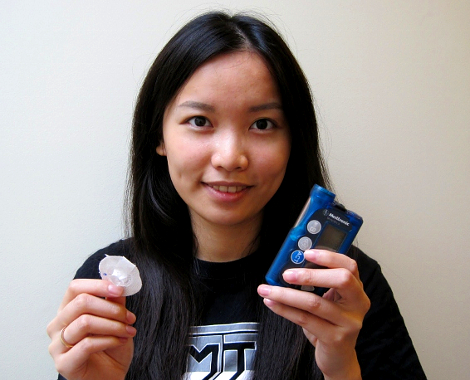
A little piece of red tape – and discovering she had diabetes – changed Wendy Peng’s career plans. Learn how her dreams changed from becoming a Wall Street business woman to a materials engineering major at the University of British Columbia in Canada.
“To be honest, I’ve always wanted to be a business woman since I was in grade seven. I always dreamed that someday in the future I would become one of the most influential women on Wall Street. The reason why I wanted to be a business woman is simple: I wanted to make MONEY. However, things changed dramatically in my 9th grade summer.
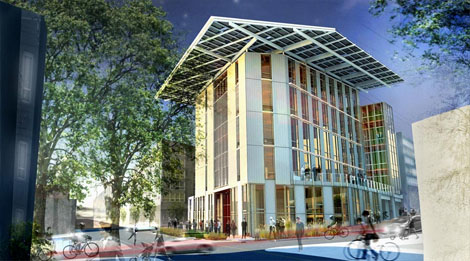
To get a LEED (Leadership in Energy and Environmental Design) platinum certificate, a building must cut energy use to about half that of a typical structure. That’s tough. What’s tougher? The Living Building Challenge (LBC).
According to Time magazine, the LBC was created six years ago, and to win certification a building must use half the energy of a LEED platinum building and have net-zero energy and water systems. So far, only three buildings have managed that feat, and they’re quite small. However, a six-story, 4,600-square-meter office building will open this fall in Seattle that’s aiming to meet the LBC requirements.
The $30 million Bullitt Center will house the Bullitt Foundation, whose president is Denis Hayes, a former staff director who worked with Earth Day founder Former U.S. Senator Gaylord Nelson.
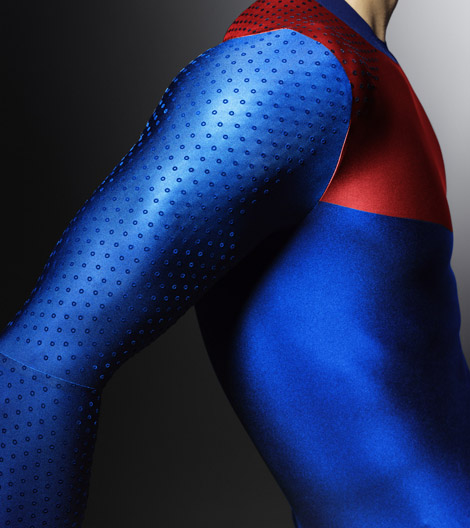
In science, speed is just distance divided by time. But in sports, where fractions of a second can determine champions, speed is everything. That’s why many athletes look to engineering for a high-tech edge that can maximize velocity and performance.
Take Nike’s new track and field uniforms — released just in time for the summer Olympics.
Smartphone addicts everywhere will rejoice at Google’s latest portable technology innovation: reality-enhancing eyeglasses. The glasses are a product of Google X, the company’s secretive experimental research lab.
The specs function much like a smartphone or tablet computer, but without the extra bulk or the screen interface. Using voice-activation, they offer wearers the latest information pertaining to their surroundings, such as weather, transportation info, and directions to the nearest coffee shop. They even have a built-in camera that allows users to snap photos of interesting sights and to video chat with friends (watch concept video above to see them in action). According to the New York Times, the glasses could be on sale as early as next year, retailing for around the price of a new smartphone.
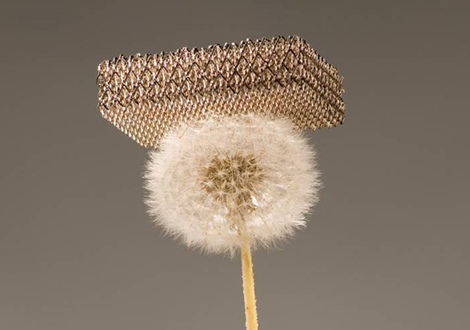
Crunchy as it appears, the structure above is no chocolate wafer resting atop a dandelion. It is metallic micro-lattice, newly christened the world’s lightest material. Created for DARPA by HRL Laboratories in collaboration with researchers at the California Institute of Technology and the University of California, this material is so light that it can balance on dandelion fluff without crushing it. However, don’t be deceived by its size or weight, as materials can actually get stronger when shrunk to nanoscale.