Posted on April 25th, 2015 by Jaimie Schock

Scholarships that target students interested in engineering provide an excellent way to help pay for the rising costs of higher education. Since engineering scholarships are plentiful and come from a variety of sources, such as corporations, non-profits, foundations, institutions, and governmental bodies, future engineers have a host of opportunities available to them.
Read More
Filed under: Aerospace, Agricultural, Architectural, Biomedical, Chemical, Civil, Computer, e-News, Electrical, Environmental, Explore Engineering, Industrial / Manufacturing, Materials, Mechanical, Mining, Nuclear, Ocean, Scholarships, Transportation | 5 Comments »
Tags: Awards, Scholarships, Scholarships and Fellowships
Posted on January 30th, 2015 by Mary Lord
 Many girls like to dance. Code? Not so much. That could change if Clemson University researcher Shaundra Daily’s choreography software catches on. It lets girls program a virtual 3-D dancer’s movements based on movements they themselves make.
Read More
Filed under: Computer, Explore Engineering | Comments Off on Shall We Dance?
Posted on November 27th, 2013 by Mary Lord
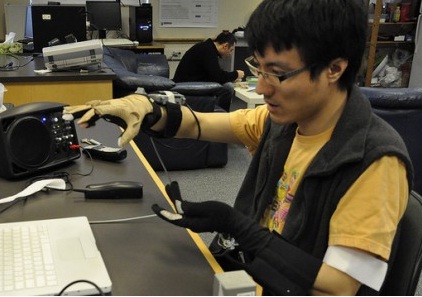 What’s in a voice? A new gesture-to-speech synthesizer developed by researchers at the University of British Columbia adds emotion to words that text-to-speech technologies now voice only in a monotone. It also translates gestures into music.
Read More
Filed under: Computer, Electrical, Explore Engineering | Comments Off on Talk to the Hand
Tags: Electrical, Felix Tang, gesture-to-voice, hand, Music, Music engineering, mute, sensors, Sidney Fels, sign language, synthesizer, University of British Columbia
Posted on June 25th, 2013 by Mary Lord

Who says science and engineering is for nerds? Not rock star will.i.am. The technology-loving Black Eyed Peas singer thinks computer coding is so cool, he’s enrolled in a programming course at the California Institute for the Arts this fall. You can take it with him: it’s a free, massive open online course known as a MOOC.
Read More
Filed under: Computer, e-News, Explore Engineering, K-12 Outreach Programs | Comments Off on Computer Science Rocks!
Tags: Computer Science, quantum physics, Robotics, rock star, STEM e, will.i.am
Posted on February 21st, 2013 by aseeadmin

Sudden infant death syndrome, or crib death, is responsible in the United States for around 2,225 deaths a year of children from birth to 12 months. But German researchers have developed a stretchable, printed circuit board that could be fitted into a one-piece sleeper and would signal an alarm if a baby stops breathing. Investigators at the Fraunhofer Institute for Reliability and Microintegration IZM in Berlin have figured out how to make the flexible, wearable circuit board from polyurethane, a plastic often used as a sealant. They fitted it with sensors that monitor breathing in the chest and stomach areas, and ironed it onto baby-size PJs.
Read More
Filed under: Biomedical, Chemical, Computer, e-News, Electrical, Explore Engineering, Industrial / Manufacturing, Materials, Mechanical | Comments Off on Smart Jammies