Posted on November 27th, 2013 by Mary Lord

Combining nanotechnology with foam, Brigham Young University engineering student Jake Merrell has created a “smart foam” that could be placed inside the helmets of football players to measure the impact of hits to the head, and help prevent concussions.
Read More
Filed under: Biomedical, e-News, Explore Engineering, Materials, Meet More Students | Comments Off on Student’s Gel Could Prevent Concussions
Tags: Brigham Young University, concussion, engineering student, football, head injury, helmet, invention, Nanotechnology, smart foam
Posted on June 7th, 2012 by Mary Lord

What do Rihanna, Katy Perry, and Lady Gaga have in common with engineering? All belt out chart-topping singles in a costume tailor-made for a techno beat and larger-than-life image: an LED dress. Wearable technology reaches beyond fashion to lightweight military armor and applications in sports, cybersecurity, and medicine. Check out these fun examples!
Read More
Filed under: Chemical, e-News, Electrical, Industrial / Manufacturing, Materials | 1 Comment »
Tags: cast, concept cast, Cornell, CuteCircuit, dye, equestrian, fabric, Fashion, fractures, Hidez, high-performance apparel, high-performance fabric, Juan Hinestroza, LED, materials engineering, MIAmobi, nanoscale material, Nanotechnology, Nike, Olympics, Pedro Nakazato Andrade, racehorse, RFID, sensors, Sports, Tags: athletics, textile manufacturing, Textiles
Posted on March 22nd, 2012 by axb
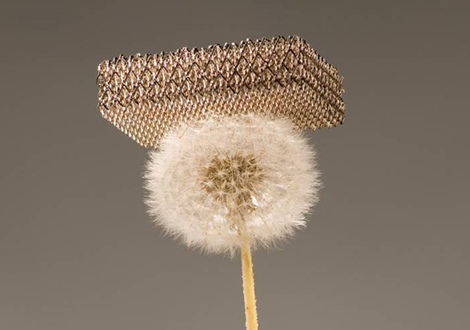
Crunchy as it appears, the structure above is no chocolate wafer resting atop a dandelion. It is metallic micro-lattice, newly christened the world’s lightest material. Created for DARPA by HRL Laboratories in collaboration with researchers at the California Institute of Technology and the University of California, this material is so light that it can balance on dandelion fluff without crushing it. However, don’t be deceived by its size or weight, as materials can actually get stronger when shrunk to nanoscale.
Read More
Filed under: e-News, Materials | Comments Off on Lighter Than a Feather
Tags: Materials, Nanotechnology
Posted on May 11th, 2011 by axb
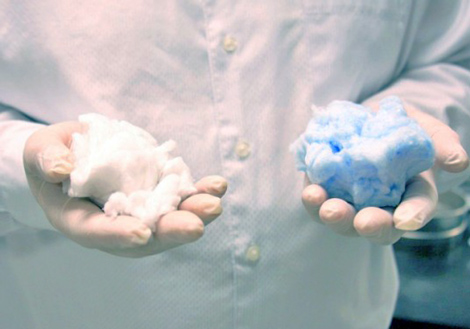
It’s not edible, but this new fiber could be the right medicine for persistent wounds.
A fluffy new material composed of glass fibers could be the latest in wound-healing technology, say researchers from Missouri University of Science and Technology. This cotton candy-like substance (pictured above) is composed of borate glass nanofibers and has been labeled DermaFuse.
Read More
Filed under: Biomedical, e-News, Materials | 1 Comment »
Tags: Biomedical, Materials, Nanotechnology
Posted on February 25th, 2011 by Jaimie Schock

The 2011 annual NanoDays, is coming in the spring, March 26-April 3. It’s not too early to get ready now.
Join the NISE network’s NanoDays 2011, a nationwide festival of educational programs about nanoscale science and engineering and its potential impact on the future, by hosting a day or a week of activities.
Read More
Filed under: Grades 6-8, Grades 9-12, Grades K-5, K-12 Outreach Programs | Comments Off on Event: NanoDays, March 26-April 3, 2011
Tags: Event, Events, Nanotechnology